Welcome to the Prehoda lab
We are a research group in the Institute of Molecular Biology and Department of Chemistry and Biochemistry at the University of Oregon

About us
Building the brain
We study how neurons, one of the most complex cell types, are made during development. We combine the latest microscopy methods with the awesome power of reconstitution biochemistry to understand neurogenesis.
- Neural stem cell dynamics - We use cutting edge imaging technologies such as super resolution microscopy in living brains to watch neural stem cells in action.
- Biochemical reconstitution - We purify and analyze the large protein complexes that are responsible for neurogenesis. We use technologies such as Fluorescence Resonance Energy Transfer to interrogate their activity.
Find out more below!
Meet the Prehoda research group
We aspire towards a kind, collaborative, and inclusive environment in which to pursue rigorous science that addresses important questions in neurogenesis, and that allows each member to continually improve their abilities as a scientist.
To inquire about joining the team, contact us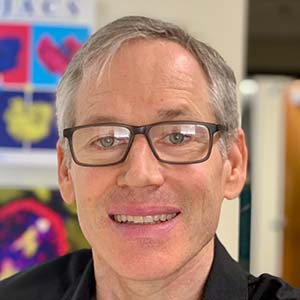
Ken Prehoda
Principal Investigator

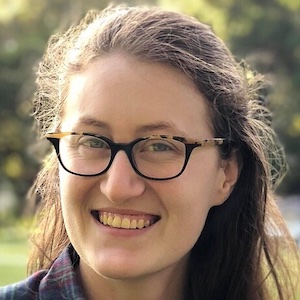
Rhiannon Penkert
Research Scientist
Animal cell polarization mechanisms
Lucy Moholt-Siebert
Graduate Student
Par complex membrane interactions
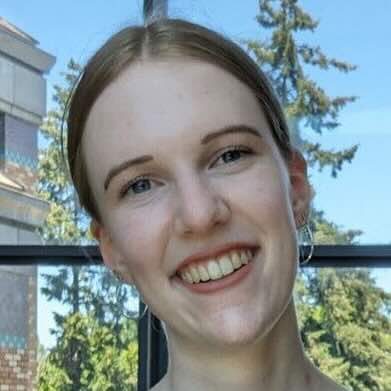
Michelle Ortman
Graduate Student
Arp2/3-mediated membrane dynamics

Sarah Welch
Graduate Student
Regulation of aPKC cortical recruitment
Take a look at the problems we study
Our research is funded by National Institutes of Health grant GM127092

We study how animals make neurons during development using Drosophila neural stem cells as a model system. Neural stem cells undergo repeated asymmetric divisions to populate the fly central nervous system. After a cycle of division, one daughter cell retains the stem cell fate while the other goes on to become neurons or glia.
The foundation of this amazing process is the segregation of the activity of fate determinant proteins into the two daughter cells during mitosis. Our work attempts to uncover the molecular basis of asymmetric fate specification through the study of cell polarity and fate determining factors.
The first step in fate determinant segregation is their polarization, in which the proteins localize to opposite regions of the cell membrane. How does the cell become organized in this way? We have studied the Par complex, a set of three proteins that polarizes many different cell types, including stem cells. A kinase, atypical Protein Kinase C, is a key component of the Par complex, as attachment of a phosphate to downstream proteins polarizes them. We are trying to understand how cells control where the Par complex is localized, and how substrate phosphorylation leads to their polarization. Loss of polarity is a hallmark of cancer, and we are also studying the relationship between polarity and tumorigenesis.
Some recent news
- April 7, 2026 - Our paper on temporal regulation of Lgl and aPKC is now published.
- March 23, 2026 - Our paper on Arp2/3 involvement in intercellular bridge constriction in late cytokinesis is now published.
- June 10, 2025 - Graduate student Dorothy Estrada joins the group - welcome Dorothy!
- June 3, 2025 - Congratulations to graduate student Laurel Moneysmith for completing her Master's degree
- April 3, 2025 - Congratulations to postdoc Bryce LaFoya who will be joining the faculty of the Department of Biochemistry at the University of Wisconsin-Madison (Ken's alma mater)
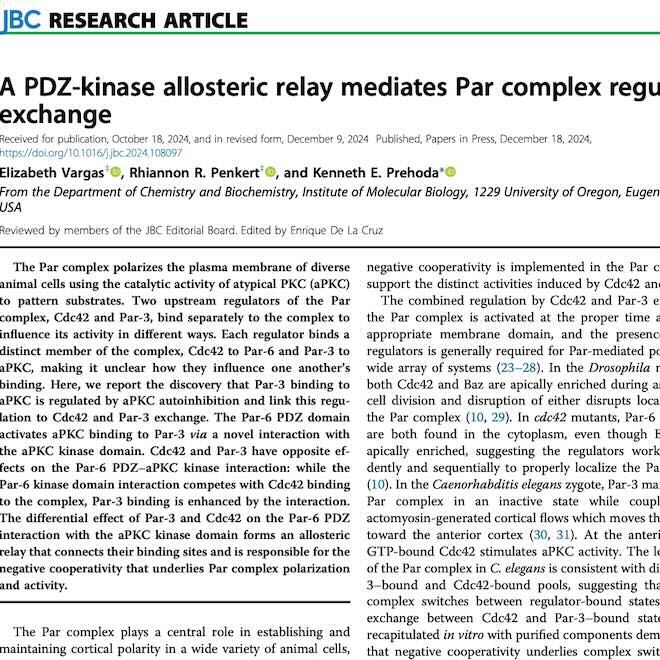
- December 10, 2024 - Our paper on regulation of Cdc42 and Par-3 binding to aPKC is published.
- June 10, 2024 - Graduate student Michelle Ortman joins the group as a joint student with the Nolen lab - welcome Michelle!
- June 3, 2024 - Undergraduate Tyler Penkert joins the group for the summer - welcome Tyler!
- May 24, 2024 - Graduate student Laurel Moneysmith joins the group - welcome Laurel!
- November 17, 2023 - Ely Vargas successfully defends her PhD thesis - congratulations Ely!
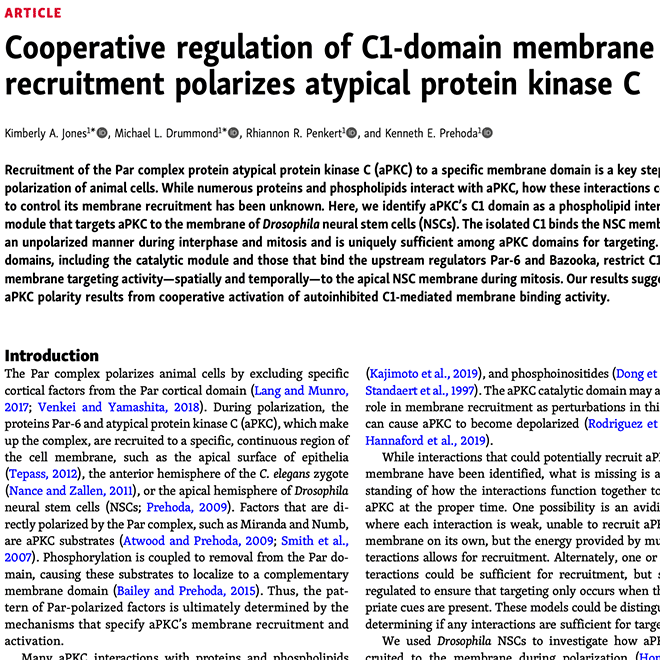
- August 15, 2023 - Our paper on regulation of atypical Protein Kinase C membrane recruitment is published.
- June 28, 2023 - We welcome high school student Kale Turner to the group for the summer!
- June 23, 2023 - We welcome graduate student Sarah Welch to the group!
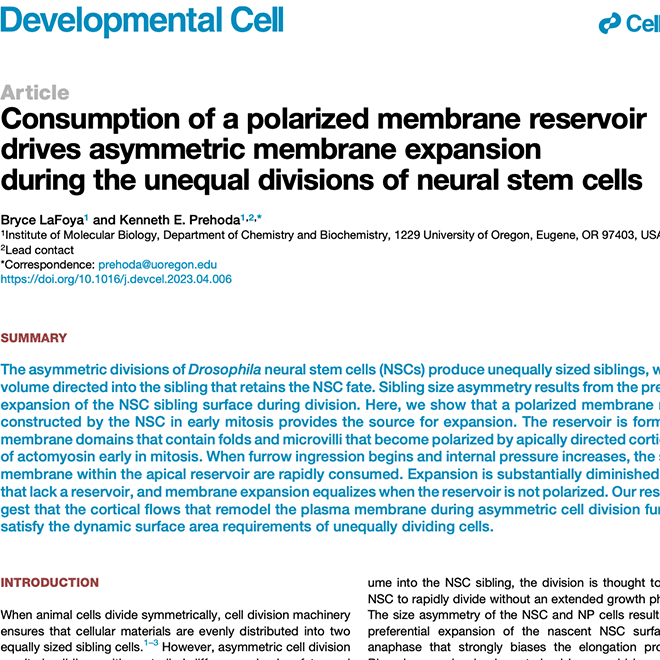
- May 3, 2023 - Our paper on membrane reservoirs in the unequal divisions of neural stem cells is published.
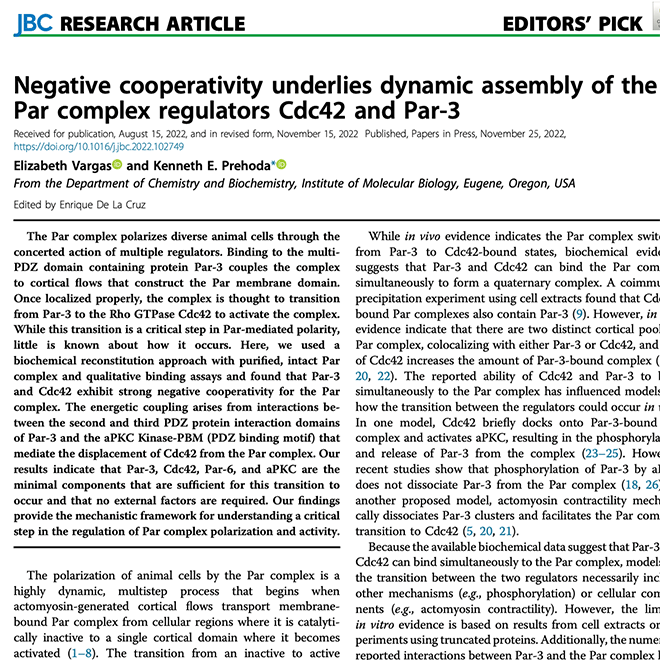
- Nov 28, 2022 - Our paper on regulation of the Par complex by Par-3 and Cdc42 is published in the Journal of Biological Chemistry. Highlighted as a JBC Editor's Pick
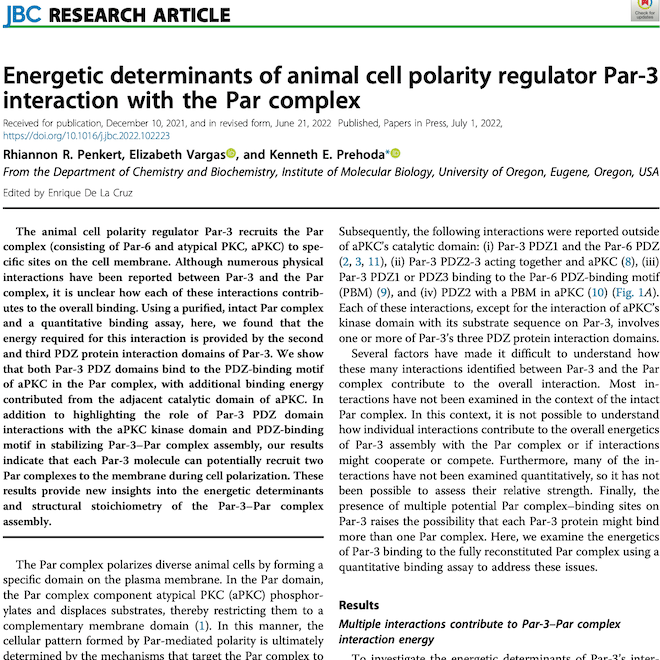
- July 1, 2022 - Our paper on the energetic determinants of the Par-3 interaction with the Par complex is published in the Journal of Biological Chemistry
- June 6, 2022 - Graduate student Lucy Moholt-Siebert joins the group - welcome Lucy!
- June 6, 2022 - Undergraduate researcher Joanne Wang joins the group for the summer - welcome Joanne!
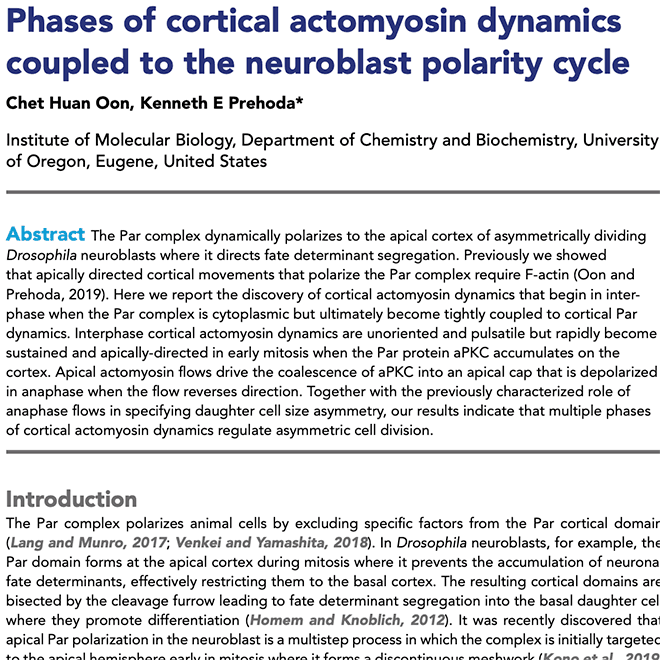
- Nov 19, 2021 - Our paper on cortical actomyosin dynamics during asymmetric cell division is published in eLife
- May 28, 2021 - Krystal Oon successfully defends her PhD thesis - congratulations Krystal!
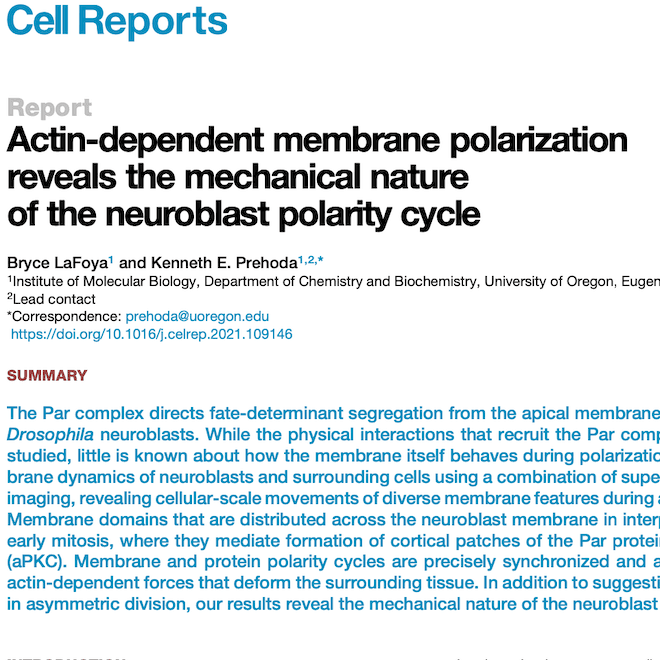
- May 18, 2021 - Our paper on membrane dynamics during asymmetric cell division is published in Cell Reports. Highlighted in Nature images of the month and the August issue of science magazine Epsiloon
Filter by Date:
Would you like to join us?
We currently have openings for a postdoc and a graduate student. Interested postdoc applicants should contact Ken directly to apply.
The Prehoda Lab accepts graduate students through the University of Oregon Biology, Chemistry, and Physics graduate programs.